How to Manage Stress Naturally When You Can't Just Remove It
Most stress advice tells you to remove the stressor, which is useless when it is your job, your kids, or your bills. What actually helps is learning to come down from the stress curve, plus the support that earned a place in my routine.
May contain affiliate links; I may earn a commission at no extra cost to you. Everything here is my opinion, not medical advice. Full disclosures
On stage, the nerves never went away. What changed everything was learning to come down from them on cue, between one entrance and the next, while my heart was still going. Managing stress in ordinary life is the same skill, not the absence of pressure but the ability to return to baseline, and almost no one is taught it.
Most advice about stress quietly assumes you can remove the thing stressing you. Quit the job, end the relationship, make the money problem disappear. For a real adult life that advice is useless, because the stress is usually your work, your kids, your bills, the things you cannot and would not remove. The question is not how to eliminate stress. It is how to stop living at the top of the curve, switched on all day, and come back down even while the pressure stays. That, a dancer can teach you, and it is mostly free.

Not sure which peptide fits you?
A couple of quick questions and the free quiz shows you where Bioactive Precision Peptides could support your wellbeing.
Take the 2-minute quizKey Takeaways
Small upgrades to your wellbeing and lifestyle. Simple, well-reviewed items to support your journey. As an Amazon Associate I earn from qualifying purchases, at no extra cost to you.

COCODOR Signature Reed Diffuser Set, Lemon Eucalyptus, 6.7oz
Oil reed diffuser with a fresh lemon-eucalyptus scent in a minimal glass bottle sized for bathroom or desk.
Check price on AmazonStress is a curve, not a switch
Your body is built to spike under a threat and then return to calm once it passes. The spike is not the problem. A healthy nervous system goes up and comes back down many times a day. The problem of modern stress is that the threats never fully pass, so you live near the top of the curve, mildly activated from morning to night, and your body never gets the signal that it is safe to stand down. That low, constant activation is what quietly exhausts people, and it is why you can feel wrung out on a day when nothing dramatic actually happened.
A performer learns this physically. Before a show the nerves arrive whether you want them or not, and the craft is not pretending they are gone, it is bringing yourself back to a workable baseline on purpose, fast, and doing it again after the next entrance. You do not get to remove the pressure of a live audience. You get to practice the return.
The skill is the return, and it is mostly free
Since you usually cannot delete the stressor, put your effort into the return. The tools that work best cost nothing. Slow your breathing and make the exhale longer than the inhale, because a long exhale is one of the few direct switches you have into the calming branch of your nervous system. Move your body, even a short walk, because motion discharges the chemistry of stress that sitting traps. Get daylight early. And set real boundaries around the two things that keep most people activated after the actual stressor is gone, which are work that follows you home and a phone that never stops asking for you.
None of that is glamorous and all of it is more powerful than anything you can buy. The basics are the work. Everything else is support on top of the work.
Get the next post in your inbox.
One email when there is something new worth reading. No spam, leave any time.
Small upgrades to your wellbeing and lifestyle. Simple, well-reviewed items to support your journey. As an Amazon Associate I earn from qualifying purchases, at no extra cost to you.

Infinity Cube Sensory Fidget Toy for Adults - Stress Relief and Focus EDC Tool
Eight-block ABS cube with metal rivets that folds and unfolds endlessly for one-handed stress fidgeting.
Check price on AmazonWhere a supplement fits
Once the free tools are in place, I do use one thing for the days that stay wound up. MAKE Wellness CALM is a bioactive peptide supplement formulated to support stress regulation, the body's ability to come back down from the curve, rather than to sedate you. I did not want to feel switched off, I wanted to stop feeling switched on all day, and what I noticed over weeks was a quieter background rather than any drowsy sensation. Like the rest of the line it shows up as the absence of something, not a buzz, and I explained how each product is built in The MAKE Wellness Products, Explained.
Its size is the same as all of them. It is a nudge layered on top of breathing, movement, and boundaries, not a replacement for any of them, and it does nothing for a day I spend glued to bad news on a screen. If you want to try the CALM I use, Click here, the discount is already in the link.
Small upgrades to your wellbeing and lifestyle. Simple, well-reviewed items to support your journey. As an Amazon Associate I earn from qualifying purchases, at no extra cost to you.
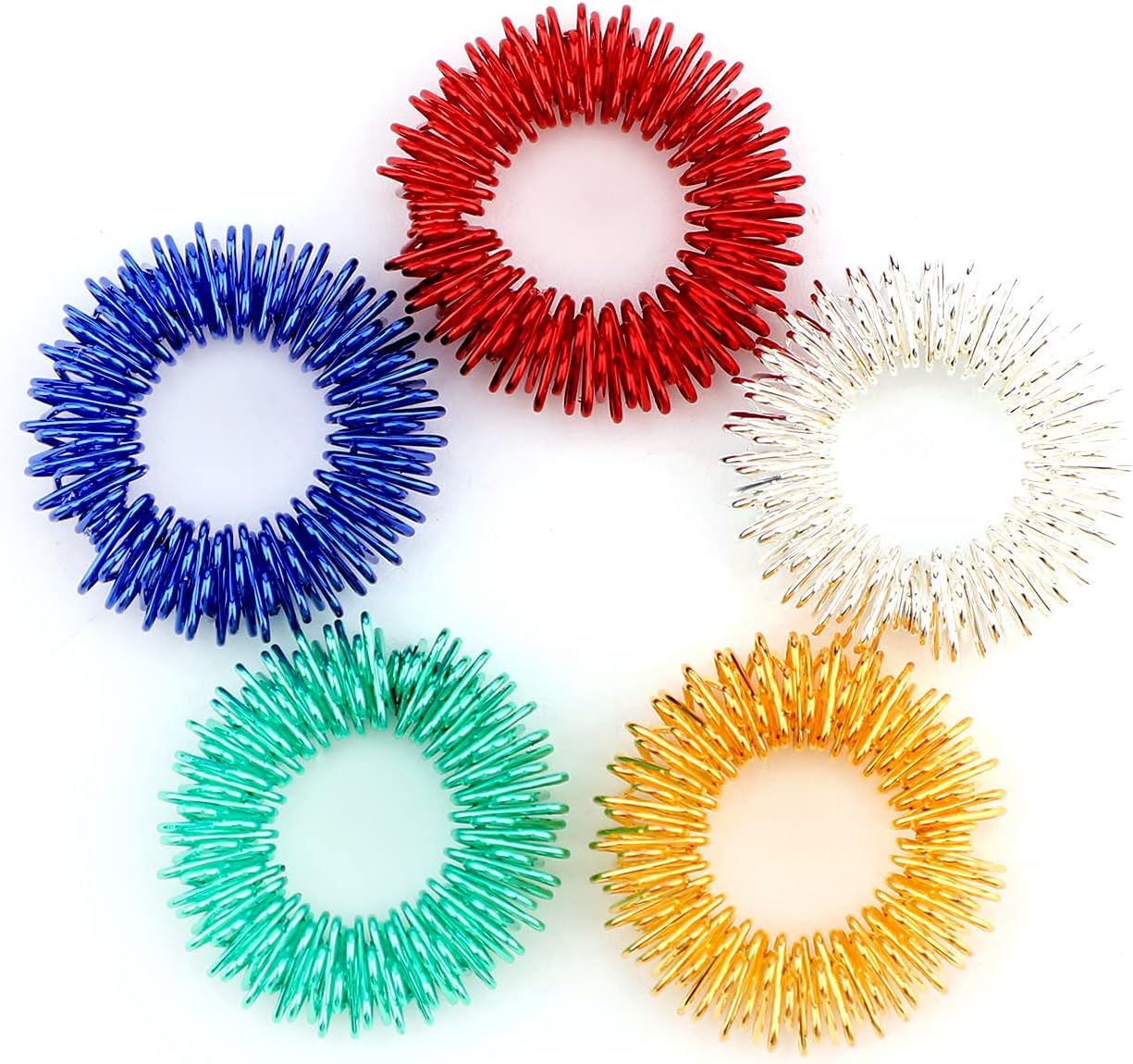
SAVITA 5-Pack Spiky Sensory Finger Acupressure Massage Rings
Five colorful spiky metal rings rolled along fingers for acupressure stimulation and quiet desk stress fidgeting.
Check price on AmazonStress and sleep are the same problem
If you treat only one thing, know that stress and sleep are a loop. A stressed nervous system sleeps shallowly, and a poorly slept body produces more stress the next day, and round it goes. Breaking in at either point helps both, which is why the calmer evening and the better night tend to arrive together. I wrote about repairing the sleep side in I Thought I Was a Heavy Sleeper, and the daytime fatigue that chronic stress produces in Why Am I Always Tired. If you are not sure whether stress, sleep, or energy is your loudest problem, a short wellness quiz will point you at the one worth starting with.

Brazilian-Canadian on Vancouver Island. Former ballet artist, current builder of small ventures. Posts here cover health, income, and the long game.
FAQ
How do I manage stress when I can't remove the cause?
Shift your effort from removing the stressor to recovering from it. Since the job, the kids, or the bills are not going away, the skill that matters is returning to baseline on purpose, many times a day, through slow breathing, movement, daylight, and boundaries around work and your phone. You are training the comedown, not deleting the pressure, and the comedown is trainable.
What is the fastest natural way to calm down in the moment?
Lengthen your exhale. Breathe in for a count of about four and out for about six or more, for a minute or two. A long exhale is one of the few direct, immediate levers into the calming branch of your nervous system, it is free, and it works anywhere. Pair it with a short walk if you can, because movement clears the stress chemistry that sitting holds onto.
What does MAKE Wellness CALM do?
CALM is a bioactive peptide supplement formulated to support stress regulation, meaning the body's ability to come back down from the stress curve, rather than to sedate you. In my own use it showed up as a quieter background through the day rather than a drowsy or switched-off feeling. It is support layered on top of the free tools like breathing and boundaries, not a replacement for them.
Can a supplement really help with stress?
It can support the body's regulation, but it cannot remove your stressor or replace the basics, and any product that claims to is overselling. The order is breathing, movement, daylight, sleep, and boundaries first, with a supplement like CALM as a nudge on top for the days that stay wound up. Treat anything promising to erase stress as a warning sign, not a solution.
How are stress and sleep connected?
They feed each other. A stressed, activated nervous system sleeps shallowly, and a poorly rested body generates more stress hormones the next day, which makes the following night worse. Because it is a loop, improving either side helps both, so a calmer evening routine often improves your sleep, and better sleep lowers your daytime stress.
When should I see a professional about stress or anxiety?
When it is persistent, interferes with your work, sleep, or relationships, or feels bigger than the situation in front of you. Ongoing anxiety is a real health matter, and a good professional helps in ways nothing on a shelf can. If yours runs deeper, please get real support.
Small upgrades to your wellbeing and lifestyle. Simple, well-reviewed items to support your journey. As an Amazon Associate I earn from qualifying purchases, at no extra cost to you.

RYVE Daily Gratitude Journal for Women: 6-Month Guided Positivity and Wellness Journal
6-month guided journal with daily affirmation prompts, gratitude entries, and weekly reflections on 100gsm lay-flat pages.
Check price on AmazonIntelligent Change The Five Minute Journal, Original Daily Gratitude Journal, Undated
Undated structured six-month journal with morning and evening positive-psychology prompts in a linen hardcover A5 format. 1.3M+ sold.
Check price on Amazon
Lamare Vision Board Book - 800+ Pictures and Quotes for Vision Board Kit, Collage Book
800+ cut-out images and motivational quotes in a magazine-style book for creating vision boards and manifestation collages.
Check price on AmazonTwo honest starting points. No pressure toward either one.

Everything I write comes from one idea: build a life you own, one stream at a time.
Want me to show you exactly how I do it, step by step, in your language? This is where it starts.
Come build with meMore in this lane.
How to Stay Motivated to Exercise When You Have No Time or Energy
Motivation is unreliable, which is why relying on it fails. What actually keeps you exercising is a system, an identity, and removing friction, from a former dancer who showed up to the barre for decades whether he felt like it or not.
How to Stop Sugar Cravings Without White-Knuckling It
Most cravings are not hunger or weak willpower, they are a mistimed signal. What drives the afternoon sugar pull, the free fixes, and what helped me.
Why Am I Always Tired? The Answer, From a Former Dancer
Tired all the time even when you sleep? The cause is usually not one thing. What drains your energy, why caffeine makes it worse, and what helped me.
Get the next post in your inbox.
One email when there is something new worth reading. Writing on health, income, and the practical reality of building a life on your own terms. No spam. Easy to leave at any time.
Unsubscribe with one click, any time. Your email stays with me and Kit, my email provider. · Privacy policy
I also publish on Substack: different essays, written for the inbox, the same long game.
Also on Substack