The MAKE Wellness Products, Explained: What All Seven Actually Do
What each of the seven MAKE Wellness peptides supports, which earned a place in my routine, and how to think about side effects. From real use since summer.

May contain affiliate links; I may earn a commission at no extra cost to you. Everything here is my opinion, not medical advice. Full disclosures
On my counter at any given time there are two or three of these, not seven. You do not need all of it, and I do not use all of it. But people ask what each one is for.
Every product in the MAKE Wellness line is a bioactive peptide supplement, built around short chains of amino acids that the body already uses as signalling instructions. If that sentence raised more questions than it answered, the plain-language version of the whole category is in Your Body Is Having 7,000 Peptide Conversations Right Now.

Get the next post in your inbox.
One email when there is something new worth reading. No spam, leave any time.

Not sure which peptide fits you?
A couple of quick questions and the free quiz shows you where Bioactive Precision Peptides could support your wellbeing.
Take the 2-minute quizKey Takeaways
Before the seven diverge, they share a base, and it is worth understanding because it is most of what you are buying. MAKE calls the platform Bioactive Precision Peptides, built around five named peptide ingredients that recur across the line: fava bean (Vicia faba) peptides, yeast (Saccharomyces cerevisiae) peptide hydrolysate, a proprietary fatigue-fighter blend, ginseng peptides, and ginkgo peptides. Each is paired with delivery technology meant to keep the molecule intact through digestion. The individual products then layer a category-specific complex on top of that shared base. So it is one foundation with seven specializations, not seven unrelated formulas.
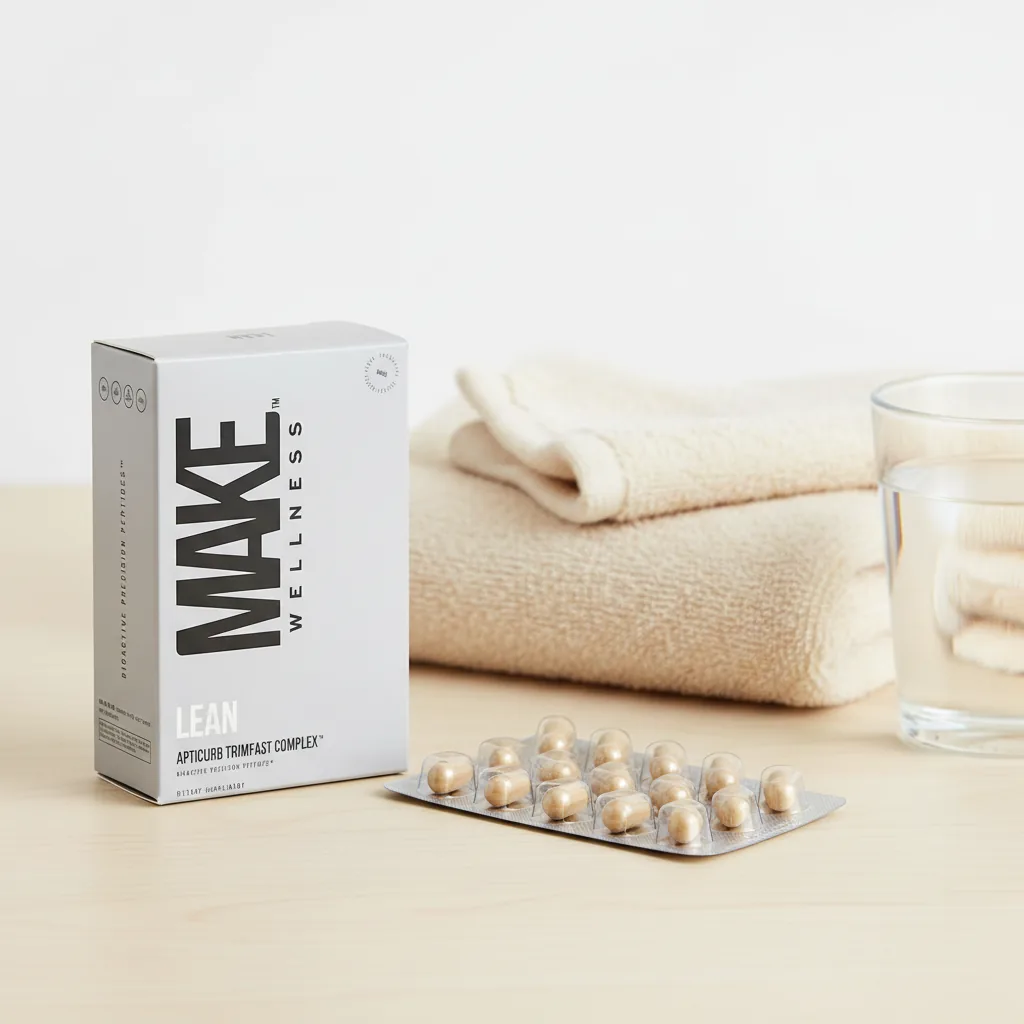
LEAN and FIT are the body-composition pair. LEAN targets appetite signalling, anchored by a complex MAKE calls Apticurb Trimfast, support for the gut-to-brain satiety conversation so it happens on time rather than three hundred calories too late. This is the category I noticed earliest in my own months on the line: less of the restless afternoon snacking that was never really hunger. FIT targets lean tissue, built around Metabolic Matrix and the PeptiStrong complex, aimed at keeping muscle responsive rather than letting it quietly slip with age. For a former dancer near forty that is the thing I think about constantly. What I noticed over months, not days, was strength and lean muscle coming back more readily, alongside the training rather than instead of it.

ENERGIZED, FOCUSED, and HYDRATED are the daily-performance group. ENERGIZED supports sustained energy by working with the machinery that produces it instead of papering over fatigue with stimulants, the afternoon crash flattening into something steadier was the change that surprised me most. FOCUSED is the mental-clarity product, built on NeuroSync Technology, formulated for the days stacked with work that needs real attention rather than just hours; like the rest of the line it is a nudge, not a substitute for sleep. HYDRATED supports cellular hydration, which is a more specific thing than drinking water, how the body actually puts water and electrolytes to work. It is the quietest of the seven in terms of what you feel.


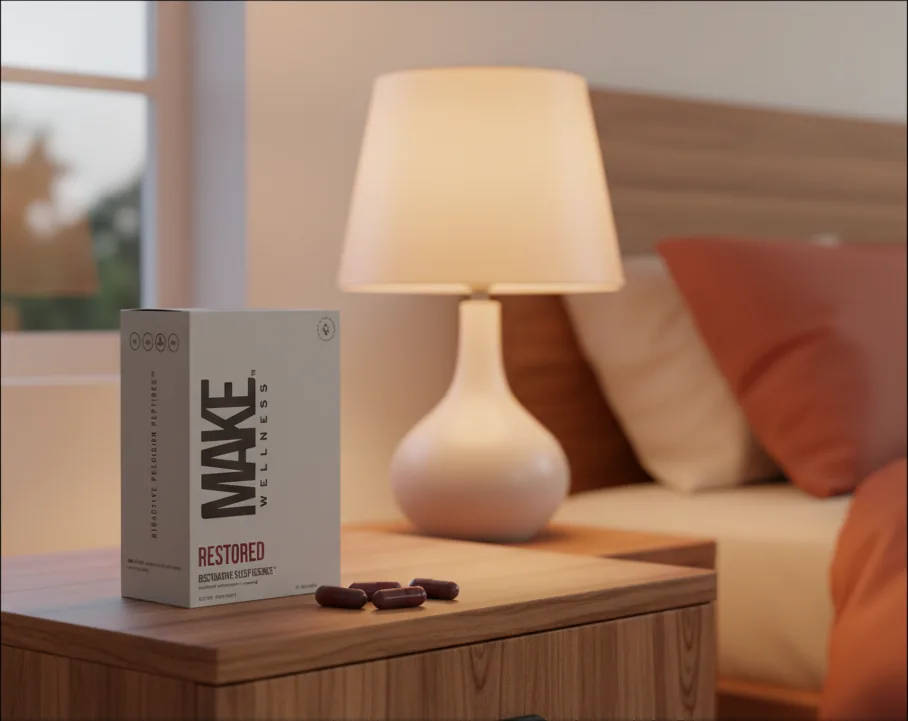
RESTORED and CALM are the wind-down pair, and RESTORED is the one I have the most direct experience with. It is anchored by PeptiSleep, a brown rice protein hydrolysate paired with L-Theanine, GABA, and apigenin, and notably it works without melatonin, which matters to anyone who has had the groggy, over-sedated mornings melatonin can produce. My own pattern is to take it a little earlier in the evening than I think I need to, because the sleep that follows is deeper when I do. CALM targets stress modulation, support for coming back down from the stress curve rather than staying wound up all day. Like HYDRATED, it shows up as an absence of something rather than a sensation.

You do not need all seven, and starting with all seven is the wrong move anyway, because you will not be able to tell what is doing what. Pick the one category that bothers you most right now, for most adults near my age that is sleep or appetite, and both are relatively easy to notice within the two-to-four-week window. If you are not sure which category is loudest for you, do not guess, a short wellness quiz walks through how you actually sleep, eat, train and handle stress, then points you at the one or two products worth starting with instead of the whole shelf. Give it a fair trial, pay attention, and add a second only if the first earns it. That is how my own routine came together, one product at a time, from the same line I still order, back when I was paying full price for it.

Brazilian-Canadian on Vancouver Island. Former ballet artist, current builder of small ventures. Posts here cover health, income, and the long game.
FAQ
What does MAKE Wellness LEAN do?
LEAN targets appetite signalling, anchored by the Apticurb Trimfast complex, support for the gut-to-brain satiety conversation rather than a stimulant appetite suppressant. In my own use it showed up as less of the restless afternoon snacking that was never really hunger.
What is MAKE Wellness FIT for?
FIT is the body-composition product, built around Metabolic Matrix and the PeptiStrong complex, formulated to support lean tissue and keep muscle responsive rather than letting it decline with age. It supports the work of training and protein intake rather than replacing it, and changes show up over months, not days.
What does MAKE Wellness CALM do?
CALM targets stress modulation, support for coming back down from the stress curve. It is support for regulation rather than sedation, and tends to show up as a quieter background rather than a noticeable sensation.
Does RESTORED contain melatonin?
No. RESTORED is built on the PeptiSleep complex, a brown rice protein hydrolysate with L-Theanine, GABA, and apigenin, and works without melatonin, which is part of why it does not tend to produce groggy mornings.
Are there side effects to the peptides?
They are built on compounds in the same family your body produces when it digests ordinary food, and the safety research on that category runs decades deep. Formulations and bodies differ, though, read the label, and if you take prescription medication, talk to your doctor about interactions before starting.
Small upgrades to your wellbeing and lifestyle. Simple, well-reviewed items to support your journey. As an Amazon Associate I earn from qualifying purchases, at no extra cost to you.

PLANTIFIQUE Rose Quartz Gua Sha Facial Tool - Anti Aging Guasha Massage Tool
Genuine rose quartz gua sha stone shaped for facial sculpting, lymphatic drainage, and jaw tension release.
Check price on Amazon
OrgaNice Hourglass Sand Timer Set, 30 Minute and 5 Minute
Dual-timer hourglass set in gift-ready packaging for meditation sessions, Pomodoro focus blocks, or kids routines.
Check price on Amazon
Weekly Pill and Vitamin Organizer, 2 Pack
Two round seven-day organizers with labeled compartments for daily routines and travel.
Check price on AmazonTwo honest starting points. No pressure toward either one.

Everything I write comes from one idea: build a life you own, one stream at a time.
Want me to show you exactly how I do it, step by step, in your language? This is where it starts.
Come build with meMore in this lane.
MAKE Wellness Peptides Review: What They Are and What Nine Months Changed
A nine-month MAKE Wellness peptides review: what the ingredients actually are, what the research supports, oral vs injectable safety, and what changed.
MAKE Wellness: What It Is, What's In It, and What Nine Months Changed
MAKE Wellness sells naturally-derived peptide supplements. What is actually in them, what is deliberately left out, and what changed for me over nine months.
MAKE Wellness Peptides Side Effects: What Nine Months Taught Me
Nine months on MAKE Wellness peptides. The real side effect profile, the regulatory line nobody draws, and the one week that felt uneven.

Get the next post in your inbox.
One email when there is something new worth reading. Writing on health, income, and the practical reality of building a life on your own terms. No spam. Easy to leave at any time.
Unsubscribe with one click, any time. Your email stays with me and Kit, my email provider. · Privacy policy
I also publish on Substack: different essays, written for the inbox, the same long game.
Also on Substack