How to Recreate a Reel: My Ladder-Closet Short, Step by Step
How to recreate a Reel with AI: pick a format that works, keep its beats, change what makes it yours, label it and credit it. One Short, seven versions.
To recreate a Reel, pick a format that is already working, keep its structure beat by beat, change everything the viewer sees so the result is yours, make it with AI where that helps, then post it with the AI label on and the trend credited. I planned my ladder-closet Short that way on October 20, 2026. It had 50,892 views when I pulled the analytics on October 23.
The structure came from someone else's video. The room, the materials and the jokes came from me, in seven versions on the same day.
Pick a format that already works
On October 15, 2026, Inna Frame posted a Facebook reel of a ladder wardrobe. A longer cut of the same build, which I kept as my main reference, shows it from start to finish: two weathered wooden ladders mounted on a wall in an inverted V with black brackets, boards slotted between the rungs as shelves, a round mirror in the middle, rails for clothes on both sides, knits folded on the shelves, shoes lined up on the floor and a styled reveal at the end.
I picked it for its shape: a transformation, a reveal and a room people can imagine owning. That shape is the first filter I use for any recreation. If you can describe the structure in one line, you can rebuild it, and your effort goes into the part that makes it yours.
Keep the structure, beat by beat
I wrote down the original's beats before changing anything:
- Open on the finished piece, as the hook, then rewind to the build.
- The two ladders prepared.
- Brackets mounted, ladders hung at an angle.
- Boards slotted in as shelves.
- The mirror placed in the centre.
- The styling pass: folded pieces on the shelves, clothes on the rails.
- The final reveal, with a slow push-in.
Those seven beats are the format. Change the beats and you are testing a new format, which is a bigger bet.
Change everything that makes it yours
Then I changed what the viewer actually looks at. My direction for the recreation, recorded the same day:
- Ladders of metal, painted black, instead of rustic wood.
- Shelves in black wood.
- Clothes: high-end menswear on the shelves, suits, tuxedos and elegant clothing on the rails.
- The feel: luxurious and modern, the opposite of the original's rustic, cozy room.
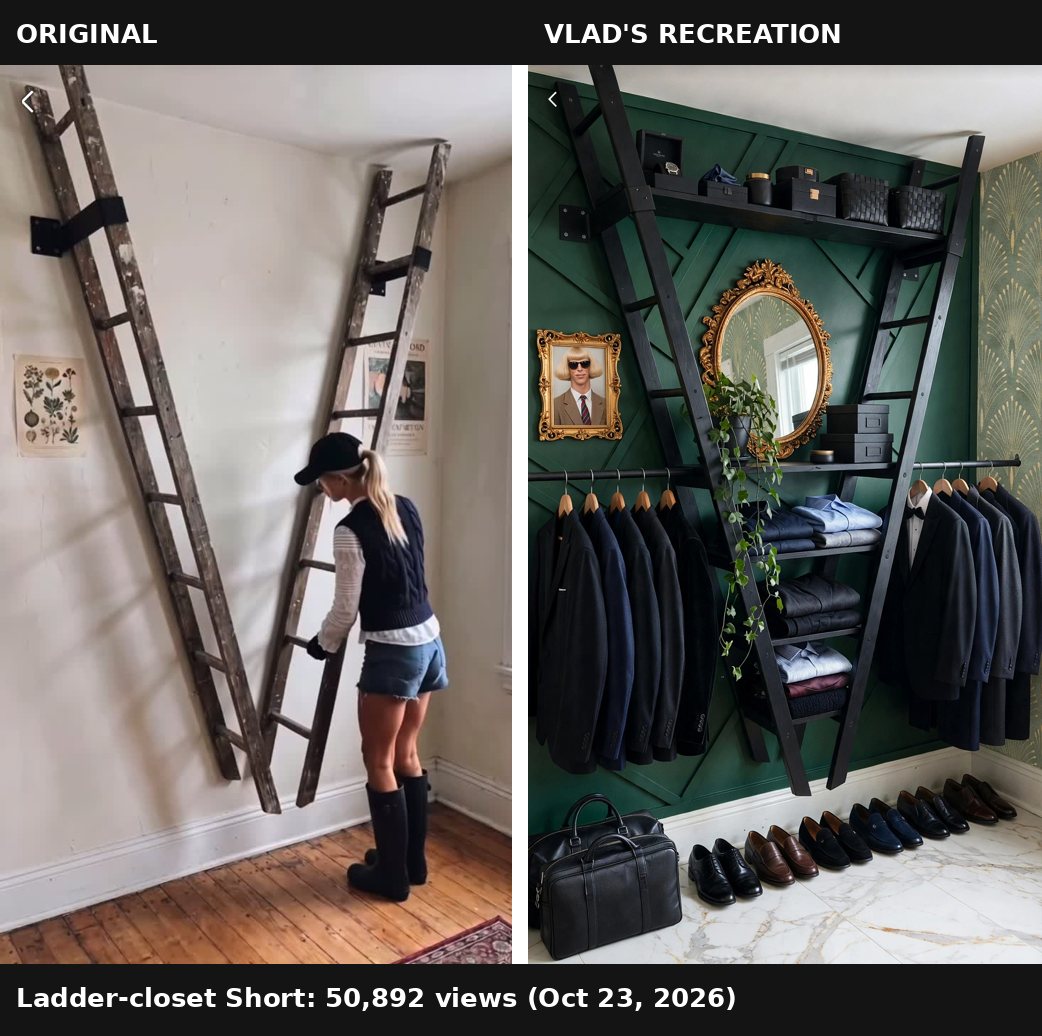 Left, a frame from Inna Frame's Facebook reel (October 15, 2026). Right, the AI-generated concept image of my recreation, version 7. The Short had 50,892 views on October 23, 2026.
The concept image went through seven versions on October 20. Version 2 added an emerald green wall with diagonal battens and turned the round mirror into an ornate gold baroque oval, with matching gold frames. Version 3 put two Easter eggs in those frames for people who follow me: a portrait of Jean Phil from my earlier videos, in a blonde bob wig, sunglasses and a curled mustache, and a selfie of me with the black bear from my bear video. In versions 3 and 4 the selfie spilled out of its frame over the ladder, and version 5 flattened it back inside. In version 6 I removed it and its frame. My note that day says why: "it is just not working." The same version replaced the wood floor with white marble veined in grey and gold, and version 7 covered the right wall in a sage green and gold art deco fan wallpaper.
Two lessons from that day. A recreation needs one detail only your audience will catch, like Jean Phil in a gold frame. And a good idea can still be cut: the bear selfie lasted three versions before I took it out.
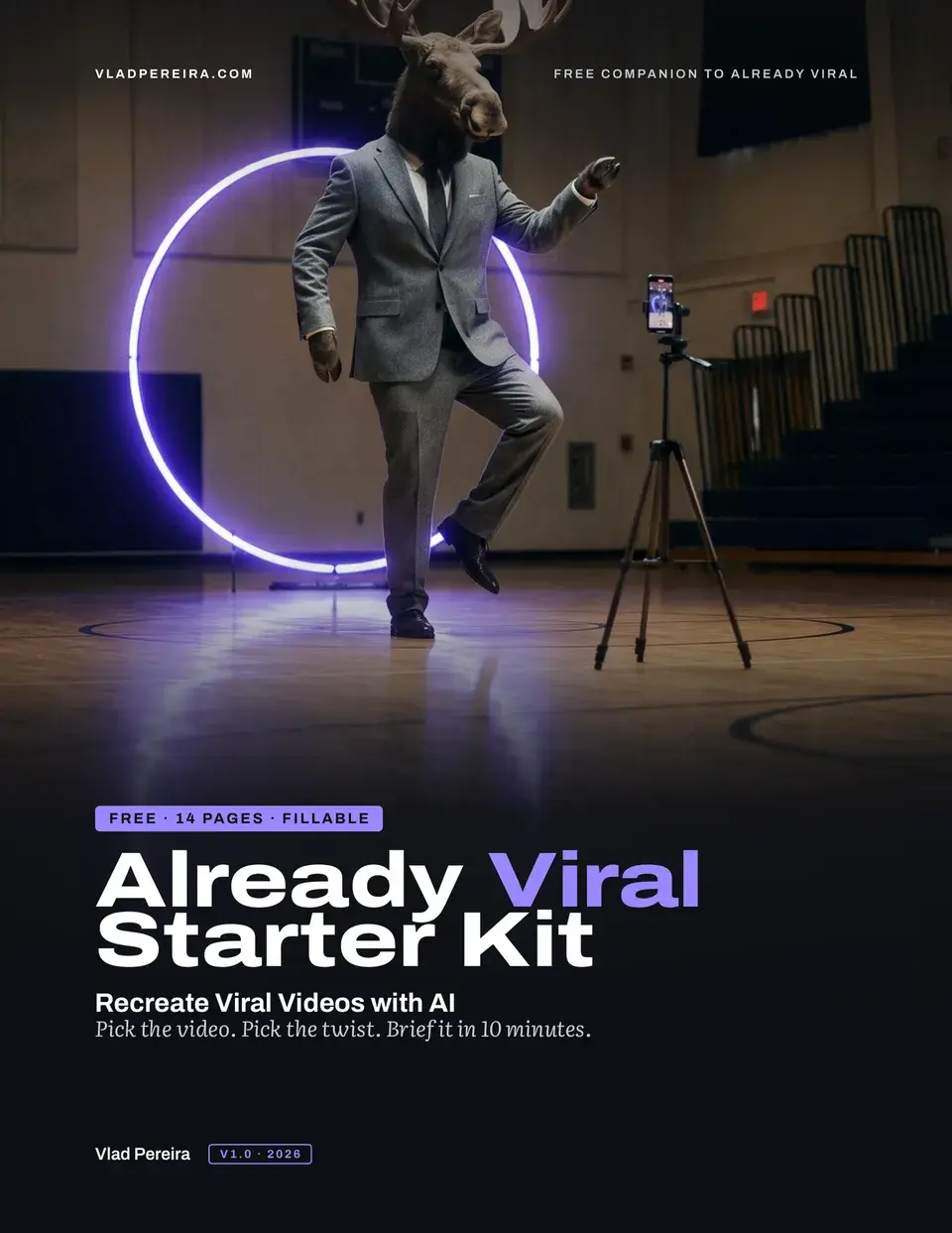
Get the free Already Viral Starter Kit
The four steps I used to recreate my first viral video with AI: pick a format that already went viral, score it, choose a twist and brief your first recreation in 10 minutes. After that, my newsletter: news, offers and updates by email from Vlad Pereira. You can unsubscribe at any time. Privacy policy
Make it with AI, and stay in charge of the cost and the faces
My process for AI recreations is in one month recreating viral videos with AI. Claude Code studies the original on my computer, its length, its frame rate and a contact sheet of one frame per second, builds a reference set from real photos, writes a character sheet, and drives Higgsfield up to the Generate button. It stops there and tells me the cost. Two things stay mine every time: approving the spend, and clicking the consent screen for every face in an upload.
The ladder closet shows no person at all, only a room and a joke portrait in a frame. That is a useful format for anyone who does not want to appear on camera.
Label it, credit it, and stay clear of the unoriginal-content rule
Two Meta rules sit on top of every recreation.
The first is the AI label. Meta's page on how to identify AI content says it may require an AI label when content has photorealistic video or realistic-sounding audio that was created or altered digitally, including with AI. One of its examples is a realistic video of people walking around an outdoor market. Images do not need a label. The page also says there may be penalties for content shared without a label when one is required. I turn the label on for every recreation.
The second is originality. In Combating unoriginal content (July 14, 2025), Meta defines unoriginal content as reusing or repurposing another creator's content repeatedly without crediting them. Meta asks for meaningful enhancements, made through creative editing, voiceover or commentary, and says stitching clips together or adding a watermark does not qualify. Accounts that keep doing it lose access to Facebook monetization programs for a period and get reduced distribution on everything they share, and duplicate videos get reduced distribution too.
A recreation built like the ladder closet sits on the safe side of both: new visuals, a label, and a credit to the trend. I also use only audio I have the rights to.
What the numbers can and cannot tell you
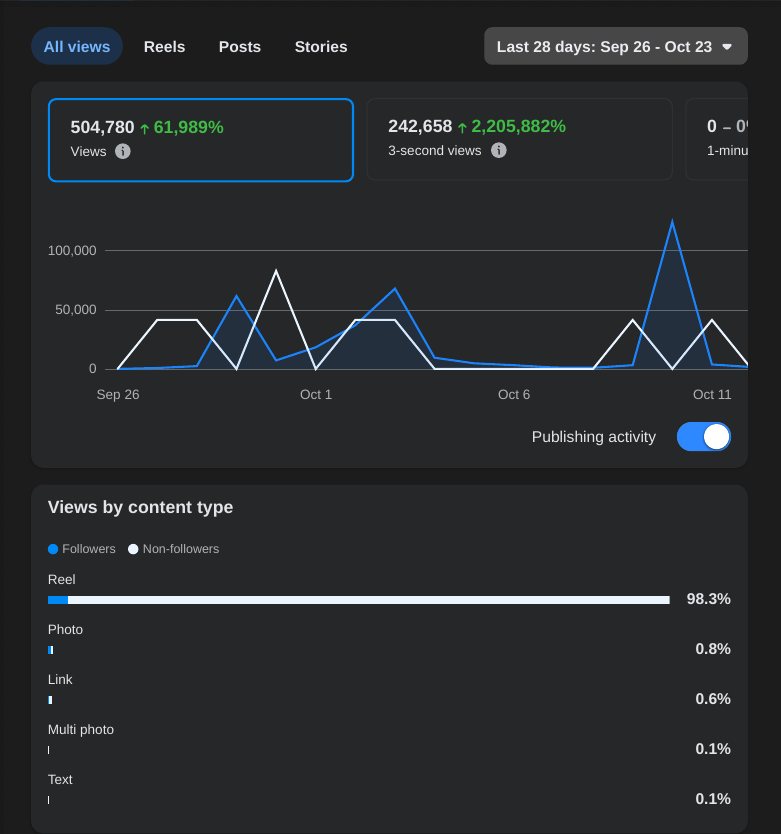 My Facebook Creator Dashboard for the last 28 days, September 26 to October 23, 2026: 504,780 views, 98.3% of them from Reels.
In the twelve months before my first AI recreation, my Facebook profile had 51,076 views. In the 14 days after it, 340,427, with 821 net follows. In the 28 days from September 26 to October 23 the dashboard above shows 504,780 views, and 96.1% of them came from people who did not follow me.
Those numbers are views. They tell you a format reached strangers. They do not tell you whether those strangers will come back, which is why the method in Already Viral continues past the recreation into the breakdown, the hooks and the email list. It is the guide I wrote from this work, with its Hooks pack.

Vlad Pereira is an artist first: a former professional ballet dancer who now works as a digital artist, graphic designer, and web and systems developer in Courtenay, British Columbia. A principal dancer with the Goh Ballet from 2009 to 2013, he designs projected backdrops for dance and theatre, builds websites for small businesses through his studio, Vlad Pereira Online, and writes practical guides to AI tools for small business owners.
FAQ
Is it allowed to recreate someone else's Reel?
Meta's rule targets reposting another creator's content repeatedly without credit and without meaningful changes, not taking part in a format. Make it your own with creative editing, voiceover or commentary, credit the trend, and use audio you have the rights to.
Do I have to label AI videos on Instagram and Facebook?
Meta says it may require an AI label when content has photorealistic video or realistic-sounding audio that was made or changed digitally, and that there may be penalties for sharing such content without a required label. Images do not need one. I turn the label on for every recreation.
How is a recreation different from a repost?
A repost shares the same video again. A recreation keeps the format, the beats and the hook, and replaces what the viewer sees: the faces, the setting, the objects, the twist. Meta's own line is that stitching clips together or adding a watermark does not count as a meaningful change.
Do I need to show my face to recreate a Reel?
No. The ladder-closet Short shows a room and no person at all, only a joke portrait in a gold frame. When a recreation of mine does show my face, it is built from real reference photos of me, and I approve every consent screen myself.
More in this lane.
One Month Recreating Viral Videos With AI: My Case Study
In the 12 months before September 27, my Facebook profile got 51,076 views. In the 14 days after my first AI recreation, it got 340,427. What I made, how Claude Code and Higgsfield built it, and the two ebooks that came out of it.
How I Built a Full EV Publication by Myself, Using AI as a Tool
A local knowledge base, an AI drafting pipeline, quality gates, and a command centre, on one PC in Courtenay for under $300. One person, a whole publication.
Side Hustles Without AI: What Needs Software and What Doesn't
Five side hustles that need no AI and no app: teaching, a local service, hand-made goods, event help and care work. Plus a rule that sorts any hustle.
 Free with the newsletter
Get the free Already Viral Starter Kit
The four steps I used to recreate my first viral video with AI: pick a format that already went viral, score it, choose a twist and brief your first recreation in 10 minutes. After that, my newsletter: what I am building, what I am learning, and the practical side of running small ventures beside a full-time job, plus news, offers and updates.
Free PDF, 14 pages, fillable. News, offers and updates by email from Vlad Pereira. You can unsubscribe at any time. I send the newsletter with Kit and Substack, so they keep your email too. · Privacy policy
I also publish on Substack: different essays, written for the inbox, the same long game.
Also on Substack