The $49 I Forgot I Was Owed
A bread price-fixing settlement paid me $49.11 while I was at the park with my kids. The case for claiming the small, one-time money most people leave behind.

May contain affiliate links; I may earn a commission at no extra cost to you. Everything here is my opinion. Full disclosures
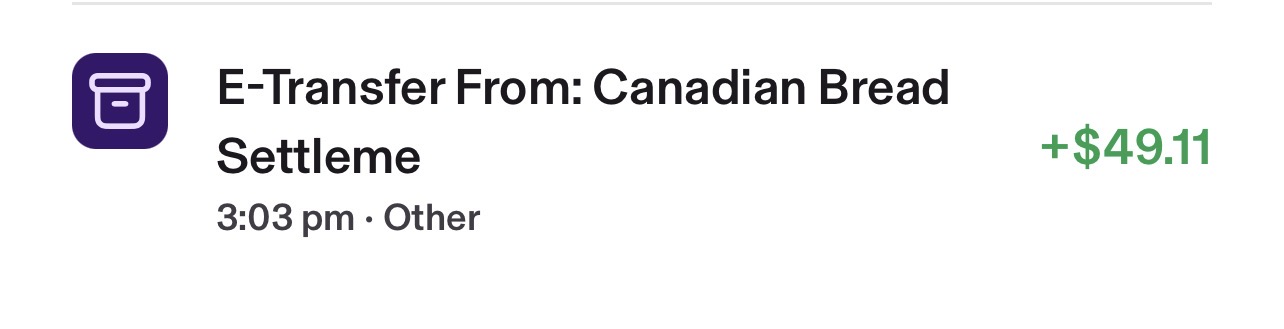
I was at the park with my kids when my phone buzzed. An e-transfer had landed, forty-nine dollars and eleven cents, from, of all things, a bread lawsuit I had completely forgotten I signed up for.
Forty-nine dollars is not a story. Nobody's life changes at the swings because forty-nine dollars showed up on a Tuesday. But I stood there grinning anyway, because I knew something about that forty-nine dollars that made it worth more than its face value. It was not the only small, unexpected thing that had landed in my account that week, and not one of them came from any of the businesses I actually run.
I write a lot about building income streams: the ventures, the affiliate work, the equity, the slow compounding river you build one stream at a time. This is not that. This is the other category of money, the one almost nobody talks about because each piece of it is too small to brag about. One-time money. Found money. The little wins.
Key Takeaways
A friend mentioned it first. We were talking about nothing in particular and he said, "Did you sign up for the bread thing?" He had just done it himself, online, a few minutes of his life. For years, he explained, the big Canadian grocery and bakery companies had been quietly fixing the price of packaged bread, the stuff in every kitchen in the country, and a class action had finally been settled. If you had bought bread in Canada during the relevant years, you were owed a piece of it.
I almost waved it off. Then I did the math any of us can do in two seconds. I have bought bread. I have two kids. I have bought a lot of bread. So I went to the site, entered the little they asked for, and submitted a claim. It took less time than deciding what to watch that night. Then I forgot about it completely.
Loblaw and its parent company, George Weston, settled the national class actions for $500 million over an industry-wide arrangement to fix the price of packaged bread sold in Canada between 2001 and 2021. The claims process closed in December 2025, and payments started landing in May 2026 by Interac e-transfer or cheque. If you did not take the $25 Loblaw gift card back in 2018, your payment was $49.11. If you did take the card, it was $24.11. I never took the card. So: forty-nine dollars and eleven cents, deposited while I pushed a swing.
Small upgrades to your wellbeing and lifestyle. Simple, well-reviewed items to support your journey. As an Amazon Associate I earn from qualifying purchases, at no extra cost to you.

This Works Deep Sleep Pillow Spray, 75ml, Lavender Vetivert and Camomile
Award-winning lavender, vetivert, and camomile pillow mist clinically tested to help users fall asleep faster.
Check price on AmazonLittle Wins Are a Different Kind of Money
My whole philosophy is that many little streams make a river. Build enough small, real, recurring income streams and together they become something no single paycheque can be. That is still the heart of it. But a stream is something you build and then tend. It asks for your attention every week. It rewards consistency.
A little win is different. A little win is weather. It is one-time, unexpected money that falls from somewhere you were not watching: a settlement you forgot you joined, a refund you did not know you were owed, a deposit that comes back, a rebate that finally clears, the cash from selling the stroller your kids outgrew. None of it repeats. None of it needs tending. You do not build it. You catch it. The only thing it asks of you is that you had a bucket out when it started to rain.
In a given week, the little wins can quietly add up to as much as one of my streams. The bread money was not even the only one that landed that week. It was just the one that made me laugh, because bread. Stacked together, the small stuff that arrived from nowhere added up to real money, and not a dollar of it came from my job or my ventures. It never showed up on a paystub. It never appeared in any business's revenue. It was just extra. And extra, noticed on purpose and collected without shame, is still money.
Get the next post in your inbox.
One email when there is something new worth reading. No spam, leave any time.
The Money That's Already Yours
A lot of these little wins are not luck at all. They are money that is already yours, sitting in a drawer somewhere with your name on it, waiting for you to be the kind of person who goes and looks.
In Canada the numbers are almost comical. The Canada Revenue Agency is sitting on more than $1.7 billion in uncashed cheques, refunds and benefit payments that simply never got cashed, and you can see your own in a few clicks inside CRA My Account. The Bank of Canada holds another $1.8 billion or so in unclaimed balances, dormant accounts and matured GICs and forgotten bank drafts, searchable by name. Several provinces, including British Columbia where I live, plus Alberta, New Brunswick and Quebec, run their own unclaimed-property registries on top of that. Service Canada holds uncashed CPP, OAS and EI payments. Between all of it there are billions of dollars in this country that belong to specific people who have never gone to collect. Some of those people are reading this.
Then there is the genre that paid for my gelato at the park. Class-action settlements are running constantly, against banks, app stores, car manufacturers, airlines, retailers, social platforms. Most of them you qualify for without ever knowing, because the qualifying behaviour is something ordinary, like bought bread or owned a phone or paid a fee. The settlement gets announced, a claims window opens for a few months, and the vast majority of eligible people never file, because filing requires you to notice and to care for the ninety seconds it takes. The people who do file get a quiet e-transfer months later, usually long after they have forgotten it was coming.
None of this is a hustle. There is nothing to build and nothing to sell. It is just money with your name on it that you have to be paying attention to receive.
Small upgrades to your wellbeing and lifestyle. Simple, well-reviewed items to support your journey. As an Amazon Associate I earn from qualifying purchases, at no extra cost to you.

Therabody TheraGun Relief Handheld Percussion Massage Gun, Quiet Motor, 3 Attachments
Entry-level Theragun percussion massager with three attachments for daily muscle soreness and tension relief, FDA-registered device.
Check price on AmazonThe Real Skill Is Noticing
My friend did me a real favour with that one offhand question, and not because of the forty-nine dollars. He reminded me of a posture I think is worth more than any single payout: pay attention, and follow through on the small stuff.
The reason most people leave this money on the table is not laziness. It is that each piece is too small to feel worth the effort. Forty-nine dollars is not worth a form. The refund is not worth the email. The CRA login is not worth digging up. So the form does not get filled, the email does not get sent, and the money stays exactly where it is, which is often enough in someone else's hands. The whole game is decided in the ninety seconds where you either shrug or you sign up. I have trained myself to sign up. When someone mentions a settlement, I check whether I qualify. When a refund is owed, I claim it. When I find an old account, I chase the balance. Each instance on its own is almost not worth it. The habit, run across a year, absolutely is.
This is the same muscle that makes someone good at the bigger opportunities. The person who notices a forty-nine-dollar settlement is usually the same person who notices the side gig, the underpriced thing worth reselling, the skill a friend would gladly pay for. Being always on the lookout is not greed. It is attention, pointed at a part of life most people have quietly decided to ignore. Sharpen it on the little wins, and it is already there when something larger walks past.
Small upgrades to your wellbeing and lifestyle. Simple, well-reviewed items to support your journey. As an Amazon Associate I earn from qualifying purchases, at no extra cost to you.

Fit Simplify Resistance Loop Bands, Set of 5
Five graduated latex loop bands for home workouts, stretching and physical therapy, with a carry bag.
Check price on AmazonBack to the Park

The grin was not about the amount. It was the timing. The money landed while I was doing the exact thing all of this is supposed to be for: standing in the sun, pushing my kids on the swings, not working, not selling, not chasing anything. I did not earn that forty-nine dollars in that moment. I earned it years earlier by buying bread like everyone else, and then by taking ninety seconds to file when a friend reminded me. In the moment, it just arrived, on its own, while I was busy living. That is the whole feeling the income streams are quietly building toward, and the little wins are an early taste of it: money that shows up while you are paying attention to something better.
Keep building your streams. That is the river, and it is the real long game. But while you build, keep a bucket out for the rain. Sign up for the thing. Check the account you forgot. File the claim. Chase the refund. Collect the money that already has your name on it. Each little win is too small to change your life, and that was never the point. Collect enough of them, stay the kind of person who notices, and you will be surprised how often the sky just opens up, usually when you least expect it, sometimes right there at the park.

Brazilian-Canadian on Vancouver Island. Former ballet artist, current builder of small ventures. Posts here cover health, income, and the long game.
FAQ
How much was the Canadian bread settlement payout?
$49.11 if you did not receive the $25 Loblaw gift card during the 2018 program, and $24.11 if you did. The payments come from the $500 million settlement Loblaw and its parent company George Weston agreed to over the packaged-bread price-fixing case.
Who was eligible for the bread price-fixing settlement?
Anyone resident in Canada who bought packaged bread for personal use between 2001 and 2021. People under 18, estates, those who opted out, and the officers and directors of the companies involved were not eligible. The claims process closed on December 12, 2025, and payouts began the week of May 11, 2026.
Can I still claim the bread settlement money?
No. The claims deadline was December 2025 and the window is closed. But settlements like this open all the time. The useful takeaway is not this specific one, it is to actually sign up the next time you hear about one you qualify for.
How do I find money I'm owed in Canada?
Start with three free places. CRA My Account shows uncashed federal cheques like tax refunds and benefit payments. The Bank of Canada's unclaimed balances database covers dormant accounts and forgotten bank money. And your provincial unclaimed-property registry covers more if you live in British Columbia, Alberta, New Brunswick or Quebec. Between them they hold billions of dollars, and searching costs nothing.
Are little wins like settlements and refunds taxable?
It depends what they are. A refund of your own money or a consumer-settlement payment is generally not treated as taxable income, while things like interest or certain prizes can be. I am not an accountant and this is not tax advice. If a particular win is large enough to make you wonder, ask one. Most little wins are small enough that the answer is "enjoy it."
Isn't this just pennies compared to a real income stream?
Individually, yes, and that is the point of calling them little wins rather than income streams. One settlement will not change your life. But they cost almost nothing to collect, they do not need tending the way a stream does, and stacked across a year they add up to real money that arrived from nowhere. Build the streams for the long game, and collect the little wins for free on the side.
Small upgrades to your wellbeing and lifestyle. Simple, well-reviewed items to support your journey. As an Amazon Associate I earn from qualifying purchases, at no extra cost to you.

COSORI Air Fryer 5 QT, 9-in-1 Compact Air Fryer with Ceramic Basket
5-quart 9-in-1 air fryer with ceramic-coated non-stick basket, 450 F capability, and a companion recipe app.
Check price on Amazon
Florensi Meditation Cushion, Traditional Zafu Style with Buckwheat Fill and Velvet Cover
Round Zafu-style meditation cushion filled with natural buckwheat hulls under a removable machine-washable mandala velvet cover.
Check price on Amazon
PLANTIFIQUE Rose Quartz Gua Sha Facial Tool - Anti Aging Guasha Massage Tool
Genuine rose quartz gua sha stone shaped for facial sculpting, lymphatic drainage, and jaw tension release.
Check price on Amazon
Everything I write comes from one idea: build a life you own, one stream at a time.
Want me to show you exactly how I do it, step by step, in your language? This is where it starts.
Come build with me
Curious about Bioactive Precision Peptides, but not sure where to start?
Take the free 2-minute Wellness Quiz. It reads your answers and shows you where and how Natural Bioactive Precision Peptides could support your wellbeing.
Take the 2-minute quizMore in this lane.
Many Little Streams Make a River
I'm not rich, I'm free. Why one paycheque was never going to be enough, and the four real income streams I'm building instead. The math and the mindset.
The Apple Watch on My Wrist Was Free
A free iPad, then a free Apple Watch, then $700 from BMO, all for opening accounts I needed anyway. Never leave a sign-up bonus on the table.
7 Streams of Income: What They Are and How to Start Building Them
The seven income streams, what each one requires, the FTC data on which 'opportunities' are actually sales jobs in disguise, and how to pick your first one.

Get the next post in your inbox.
One email when there is something new worth reading. Writing on health, income, and the practical reality of building a life on your own terms. No spam. Easy to leave at any time.
Unsubscribe with one click, any time. Your email stays with me and Kit, my email provider. · Privacy policy
I also publish on Substack: different essays, written for the inbox, the same long game.
Also on Substack